Showing posts with label Shinen. Show all posts

Monday, November 12, 2012

In Response to The Gravity of the Uninitiated


In response to Bubbler's post "The Gravity of the Uninitiated"


You've written:
"The root of the problem here (and source of the symptom) is that a label [such as the words 'gay' or 'queer'] that is watered down becomes a becalmed idea."
I actually see a different root of the problem: In that some people experience the inclusion of multivariant definitions to a word or an identity-label as a 'watering down,' and others experience this inclusion as coalitionary, empowering, and nourishing.

And once again, we don't have to 'pick one'. Inclusion can be both a 'watering down' AND a 'liberation', depending on a whole host of factors, such as context, and even how we simply happen to be feeling that day (and indeed, perhaps any pre-existing relationships we may have with anyone in the room).


You've also written:"I fully acknowledge and revel in the incredible passion and warmth of a discussion like this - there's this hope to be inclusive, to move as one, which I find attractive."

And I would also like to acknowledge that we share in this attraction to a politics of inclusion (of diverse manifestations of 'queerness'), one which can and did involve incredible passion and warmth.


and you continue with:
"But there's also this sense of breathlessness - something encountered in art galleries where the blurb on the side of an art piece acquires this almost hysterical academic voice to validate itself and its own interpretation."


Well:
At the risk of re-inscribing any degree of condescension: This stuff is hard.

Like you, I was pretty uncomfortable with some of how the evening went. More accurately, I felt annoyed and upset. I was rather confronted by some of the roles that I saw us all falling into: Exasperated "Educators", the defensive "Uninitiated", some desperate "Pastoral" attempts at integration, bringing it back, centering, humble reminders of our common humanity...


More personally:
One of the ways that I have come into my own political consciousness (rightly or wrongly) is through an "academic voice", which I think you correctly point out can and does sometimes lead to a vanguardism which, in its own way, becomes a hindrance to the inclusion and emancipation that we are all (at least in theory) committed to.

You make an important, emotive point here about the importance of keeping knowledge accessible, rather than available only to the ranks of the initiated.

That said: Language is always simultaneously, and paradoxically, inclusive and exclusive: It includes those who speak it, who learn it, who feel liberated by what its parameters paradoxically enable, and excludes those who do not speak it, cannot speak it, do not want to or cannot learn it (either from lack of access or from righteous indignation), and who thus may experience neither its full limitations nor its transformative liberations.

On one level:
Part of what's involved in doing this anti-oppression work is precisely that our preconceived ways of knowing or understanding the world along the lines of race, nationality, ethnicity, spirituality, gender, sex and sexuality (and so on) are completely and utterly broken open.

Also, a la Alika's poem in "Pariah" -->
"Heartbreak opens onto the sunrise 
for even breaking is opening 
and I am broken, 
I am open. 
Broken into the new life without pushing in, 
open to the possibilities within, 
pushing out. 
See the love shine in through my cracks? 
See the light shine out through me? 
I am broken, 
I am open, 
I am broken open. 
See the love light shining through me, 
shining through my cracks, 
through the gaps. 
My spirit takes journey, 
my spirit takes flight, 
could not have risen otherwise and 
I am not running, 
I am choosing. 
Running is not a choice from the breaking. 
Breaking is freeing, 
broken is freedom. 
I am not broken, 
I am free. "


Brokenness is Freedom. And in this, we are Free...
And, as I tried to express during film night, this freedom is not always pleasant...

What are the alternatives?
All of us have been so broken, at various points in our lives, around any number of diverse, sometimes all-consuming issues.
And all of us have yet to be broken, still, further.
And in this brokenness, we may derive new languages, new ways of being with one another.

All of us, in a sense, have to be fully 'Uninitiated', from all that we have known, and indeed even all we have yet to know, before we can see that wellspring of true liberation, beyond all language: That shines through the cracks. Deconstruction does not only end in rubble...

May we all be Beginners with one another.

Wednesday, November 07, 2012

Mobile Cultures: New Media in Queer Asia


Eight years ago, in 2004, when I was 19 (almost 20), I read this book:

Mobile Cultures: New Media in Queer Asia (Duke University Press Books, 2003)

and wrote a review about it on amazon.com (I gave it 4 stars)

Given that the book's gamut of editors and contributors are mostly Melbourne-based, I figured it would be good to revisit this work by re-publicising it here... I haven't read the book since 2003, but here is a repost of my old amazon.com review, verbatim...


"Extremely Comprehensive, August 7, 2004
The most enlightening thing that this book has done for me was to get me to recognise how the term "Queer" can be just as hegemonic and oppressive as compulsory heterosexuality. The essays written about queer sexualities in Asia reveal an even more complex understanding of the workings of human sexuality than Western Queer discourse would be inclined to argue for.

As we enter an age of a new colonialism with the spread of Western culturally subversive attitudes and ideologies through various forms of mass media such as the internet, magazines and television, sexuality in Asia is changing its shape in response. I loved Tom Boellstroff's essay "I Knew It Was Me: Mass Media, "Globalization," and Lesbian and Gay Indonesians," on the 'gay' and 'lesbi' communities in Asia that came to occupy their subject-positions through an appropriation of the English terms 'Gay' and 'Lesbian' within the Indonesian cultural context, with a different set of definitions.

The essays on Japan were extremely thought provoking for me, as they bring up discussions on Japanese women's "Yaoi" (homoerotic boy-love stories and depictions), "Nyuhafu" (the Japanese transgendered, who occupy unique socio-economic positions in Japanese culture), the aesthetics of Japanese fiction when viewed and commodified by the Western gaze, "Kawaii" (or 'cute') as a possible form of subversive female identity by the masochistic embrace of child-like femininity to the extreme, and the adoption of a Japanese aesthetic in order to make an extreme genderqueer porn by Taiwanese-American filmmaker Shu Lea Cheang.

I enjoyed the essays on Singapore and Malaysia as well, having come from the region myself, as they discuss a unique embrace of a new hegemonic "Asian values" as a defensive response to the growing cosmopolitanism of the country which those in power feel brings in countercultural Western sexual values.

My only disappointment was the essay "Syncretism and Synchronicity: Queer'n'Asian Cyberspace in 1990s Taiwan and Korea" by Chris Berry and Fran Martin, because of the fact that it was primarily a list of statistics to showcase broad points, when in fact the actual number of people covered in these statistics was too small to make any generalised comment on the queerscape of these two very different countries. It became less of a comparison of these two nations more than it became a tedious and unsuccessful attempt at compare and contrast.

All in all, however, it is an incredible read, and a very well-researched book that I had difficulty putting down once I picked it up."


Incidentally, some of the editors of Mobile Cultures also edited the 2008
AsiaPacifiQueer: Rethinking Gender and Sexuality
(Illinois University Press, 2008)

Here is a blurb from Hares & Hyenas describing this book:

"A multidisciplinary, multicultural reassessment of gender and sexuality in the Asian Pacific
This interdisciplinary collection examines the shaping of local sexual cultures in the Asian Pacific region in order to move beyond definitions and understandings of sexuality that rely on Western assumptions. The diverse studies in AsiaPacifiQueerdemonstrate convincingly that in the realm of sexualities, globalization results in creative and cultural admixture rather than a unilateral imposition of the western values and forms of sexual culture. These essays range across the Pacific Rim and encompass a variety of forms of social, cultural, and personal expression, examining sexuality through music, cinema, the media, shifts in popular rhetoric, comics and magazines, and historical studies. By investigating complex processes of localization, interregional borrowing, and hybridization, the contributors underscore the mutual transformation of gender and sexuality in both Asian Pacific and Western cultures. "


Could be worth exploring (I haven't read it... (yet?)) in a later post... 

:)

Tuesday, November 06, 2012

Coloured Paper...


A few days ago, the Australian Government released
The White Paper : Australia in the Asian Century, which "sets out a strategic framework to guide Australia’s navigation of the Asian Century."

The official website says more:
"The scale and pace of Asia’s transformation is unprecedented and the implications for Australia are profound. Australia’s geographic proximity, depth of skills, stable institutions and forward-looking policy settings place it in a unique position to take advantage of the growing influence of the Asian region.
The Australian Government commissioned a White Paper on Australia in the Asian Century to consider the likely economic and strategic changes in the region and what more can be done to position Australia for the Asian Century"


An example of an action that the paper raises is around a long-term investment in "Asia literacy", including mandating that schools across Australia will teach at least one of four priority Asian languages (Mandarin, Hindi, Indonesian, and Japanese).

This, of course, has interesting implications for our national identity. Australia has, colloquially, tended to be referred to (by others, and also self-referentially), as a "Western country," despite being more accurately geographically situated as an island in the South Pacific (Northwest of Aotearoa New Zealand, and mostly actually Southeast of our closest continental neighbour: Asia)...

The word "Western" is very loaded, of course, and I interpret this to mean that Australia tends to trace its national heritage to European, U.S. American, and Anglicised continental roots, while paying lip service to our indigenous Aboriginal heritage. Another connotation of the word "Western," beyond cultural legacy, is of course the suggestion of Whiteness...

There is something quite powerful, as a statement, about nationally committing ourselves to being more geographically honest, in this regard, while also being most economically feasible as a long-term national and cultural investment in this sort of regionalism, in Asia...

A wonderful essay has been written in the Sydney Morning Herald which explores some of these implications...:


Australia's Asian-ness is barely visible
by Tim Soutphommasane


Now, I am no politician nor economist, but as a layperson, and as a citizen, I write this post as mere conjecture:
As a queer Asian-Australian man, the thought of an "Asian Century" intrigues me.

The phrase itself speaks to the part of me that is perhaps embarrassingly parochial... Since I was 3 years old, and until recently, I have not lived in a country in which I was a citizen, nor, since my adult life, one in which I was part of a racial or ethnic majority... I am, of course, simultaneously critical of the ways that nationalist identities can and do reinforce certain forms of racial and cultural supremacy. Extreme nationalism to me has often been suggestive of violence, and at least in the context of the USA and Australia, a subtle and not-so-subtle White supremacy.


And then:
There is something in here, in the metaphor of the "White Paper" and the "Asian Century" which interests me, from a queer perspective.


First, to play with this:
What of a metaphor of Coloured Paper?
(as a metaphorical canvas upon which we could explore policy as well as culture?)

What of a Queer Asian Century?

What does multiculturalism look like, outside of a "Western" framework?
What room is there, given the explicit use of the term "Asian" (as opposed to, for example, "Eastern"), to raise issues not just of multiculturalism (such as Australia has done thus far), but also of multiracialism (e.g. in the case example of Singapore)...? What are the implications of including this explicit discourse of race, given the racially-charged name of the "Asian Century"?
As Soutphommasane has written, where are all of the Asian people in this country already, in terms of being featured in positions of civil service?
What would it mean to inherit a British Parliamentary system, including a number of the cultural 'advancements' that we have made as a country for example around the decriminalisation of homosexuality, when we contrast this with other countries in Asia (or the Asia-Pacific region)?

What happens when a baton is passed, from an Anglo-normative government to a pluralistically Asian-normative government?
Is this actually going to happen?

And what will race look like in such a context?
What will racism look like in such a context?

Third Wave Poco Asian Politik


from AngryAsianMan


A reflection on Waves.
I first learned of the metaphor of 'waves' of activist leanings from feminism. While arguably Eurocentric in its articulation, I still find it a helpful metaphor when considering some of the emergent sense of identity in being Asian in Australia.


Briefly, and from wikipedia:
1st Wave feminism
focuses on de jure inequalities (or sex/gender-based inequality enshrined in law)... The first of the most important struggles was/is of that to vote (to participate as full citizens in a nation).

"Women deserve the right to vote"
2nd Wave feminism
sees a slow shift to de facto inequalities (or sex/gender-based inequality enshrined in non-state-based institutional practices, as well as in socio-cultural norms). One of the major cultural issues I see at play here is, in particular, the importance of advocating for increased participation of women in historically demarcated 'male' or 'masculine' spheres of influence (e.g. 'public' spheres, managerial/government positions, etc.)

"Equal pay for Equal work!"
"Rights, not Roses!"
"The Personal is Political!"


3rd Wave feminism
sees yet another shifting disposition, into politicising the intersectionality of gender as one of and among many factors that constitute the lived material reality of women's lives. Thus a focus on pluralism, multiculturalism, inclusivity of sexual diverse, transnational discourse, migrant women's issues (as opposed, strictly, to woman-as-citizen) etc.
Here also: the 'reclamation' (or simple 'claiming') and radical valuation of positions historically constructed/demeaned as female/feminine: e.g. Slut-walks, 'lipstick feminism,' etc.

"The Master's tools will never dismantle the Master's house" (Audre Lorde)
"Stop slut shaming!"


Once again, I recognise that this is a very broad and sweeping brushstroke. I certainly do not mean to diminish the diversity and specificity of the actual histories and herstories of feminism(s) as it/they have unfolded til the present and hereafter.

My interest here is not in feminism per se,
but about the way that feminism, as a movement (or series of movements) has been historicised into 'waves'.
(i.e. my interest is not in history, but in historiography)


Can this metaphor of waves be helpful in considering the unfolding of postcolonial/diasporic Asian-ness (within Euro-/Anglo- American/Australian-dominant spaces)?


Here is a beginning stab at what this might mean:

1st Wave Poco Asian Politik
We see first the waves of migrants from Asian countries into European/White-dominated national settings, fighting around de jure inequalities... Most simply: To be regarded as naturalised citizens. Sometimes, historically, at least in the USA, as far as I know, this has taken on the fight by some ethnic migrants (particularly those of Indian and Japanese descent, as far as I am aware) to be regarded as "White" by the state (and thus be conferred citizenship).

"Let me be a citizen!"


2nd Wave Poco Asian Politik
We see new naturalised Asian citizens struggling around de facto inequalities, particularly pertaining to profession and cultural membership. These include being seen as individuals in highly individualistic cultures, politics of representation in historically white-dominant spaces. For some Asian men (certainly for myself), this can sometimes take on a body-politik of fashioning myself as passably 'masculine,' given Eurocentric body-/and behavioural norms.

"I speak English!"
"Asian men can be muscular / hot / athletic!"


3rd Wave Poco Asian Politik
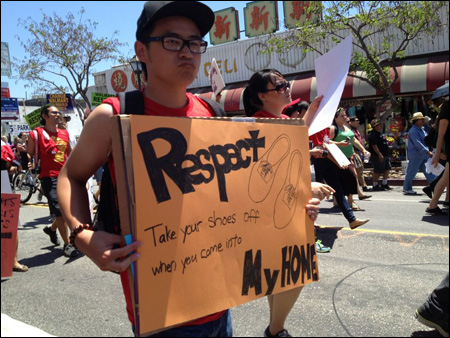
Here, the issue of intersectionality... And also about the 'reclamation' (or simple 'claiming') and radical valuation of positions historically constructed as Asian/"Asiatic," particularly by those who experience the entitlements and privileges of citizenship.

"RESPECT: Take your shoes off when you come into my home"


Let's see how this one unfolds...

Acknowledging, for now, some of my limitations in this post:
Where women have been constructed as Euro-/White-/American women
and examples of Poco Asian Politik have been male...
No explicitly queer examples ------>        >:(

Wanting to expand and rectify in future posts.

Hello! I'm Shinen

First, a preamble ...
On the back of hosting a Queer People of Colour Leadership and Social Change meeting at the Melbourne City Library last Saturday (3rd Nov 2012), a small group of us, comprising:

Shinen (myself)
Miyuki
Tim
Fei
and Jacqui

brainstormed creating a blog as a platform to share ideas and create community here in Melbourne. Tim has since created this lovely prototype of a blog, the Melbourne Colouring Book...

The truth from me, is that our first meeting was majority of Asian descent, and there is a certain disingenuity that I feel in myself in being able to represent all people of colour in the context of this space. Tim has wisely, thus, carved out this honest space to explore the specificity of Queer Asian subjectivities here in Melbourne, with my added shared intention of being open to exploring broader themes that concern other queer people of colour...


About Me:

Ok, in general, I'm not as smarmy in real life as this picture may suggest, but my self-concept is that I'm camera-shy, and have few other good pics of myself to share at the moment (that... you know... aren't all meticulously crafted for a gay personals site).

My name is Shinen.

I have a blog that I co-write with my older brother, called Psychonaut Erotica, where we explore a range of issues, all in the theme of "transforming postmodern malaise through meditative inquiry".

I was born in Malaysia in 1984, and am ethnically Hakka, Hokkien, Cantonese, and Peranakan in my heritage (though, I suppose if we want to go far enough back, chances are there's some Mongolian-Chinese border stuff going on). When I was 3, I moved to Singapore, where I was raised in an English-speaking family, going to English-speaking schools, and feeling resentful about being taught Mandarin from textbooks that emphasised heteronormative Confucian values.

(incidentally, it was in one of these schools, an all-boys Methodist school, that I first met Tim, who posts here as Bubbler)...

I lived in Singapore until I was 18, after which I went to Dartmouth College, in rural New Hampshire, USA, for University, where I studied Gender Studies and Comparative Religion (among many other interdisciplinary things... such is the nature of a liberal arts degree).

I graduated in 2007 and moved to San Francisco, where I began my more professional forays into the world of health promotion and non-profit industrial complex-ities. More on that in later posts, likely...

I moved to Melbourne in June 2008, because I couldn't get a work permit to stay in the USA continuing my work around condom-reinforcement based sexual health work for Asian gay men... From San Francisco summer to Melbourne winter.

MAJOR Sad Face.

In October 2008, I moved to Sydney, where I began writing for Fridae.com (now Fridae.asia), graduated from University of Sydney with a postgraduate degree in Buddhist Studies, and followed all that up with 3 years of additional work experience in sexual health promotion for young gay men.

Along with my wonderful colleagues Min & Kevin, I co-edited A-MEN magazine, which was funded as an HIV and sexual health promotion magazine for Asian Gay Men... You can view a copy of it here:

I moved back to Melbourne in March 2012 to start afresh and explore some new directions.

....


This autobiographical post is a chronologically-orderly narrative about my journey til this "now" moment, and has mostly explored the What-Happened of my life... In future posts, I would like to be more specific about my intentions around generating some discourse and dialogue around Queer Asian-ness in Melbourne and Australia at large, while making room more broadly for the inclusion of narratives, ideas, and explorations about queer people of colour, with other like-minded bloggers.